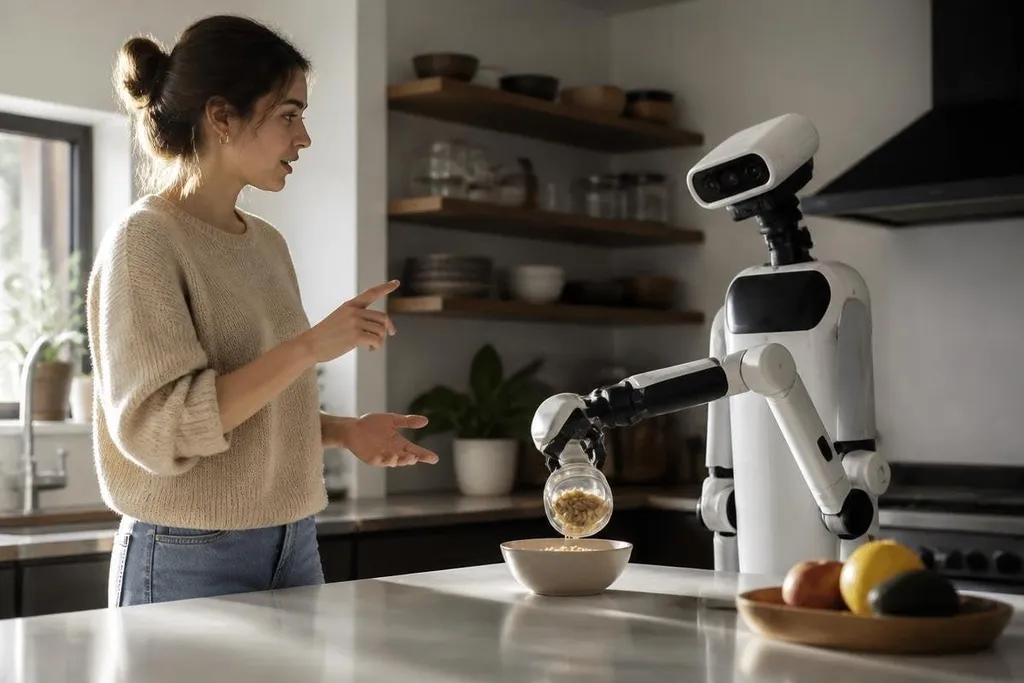
Spoken requests can get an answer in seconds, yet that exchange says little about how useful the system is. The hard work starts when it must remember the task, read the room, act safely, and admit when it doesn't understand.
For conversational robots to move beyond demos, speech must connect to physical action and clear limits.
Quick read
- Speech is only one part of the system
- Memory and task planning decide whether talk leads to useful action
- Safety rules must take priority over natural conversation
Conversation needs a job
The system combines speech recognition, a language model, sensors, and software that sends commands to motors or other systems. The language model handles words, while the rest of the robot checks what is possible in the physical world.
That split matters. A person can ask a robot to bring a cup, but it still has to locate the cup, identify a safe route, check its grip, and decide where to place it.
A fluent answer does not prove that any of those steps will work. The useful question is task-based: what can the robot finish after the conversation ends?
One that answers questions may suit a reception desk. A machine that carries out requests needs a much wider set of controls, sensors, and recovery steps.
Memory changes the exchange
A short command is easy to repeat. Longer work needs context. If someone asks a robot to move a box, then says “the smaller one,” the system has to connect the second phrase to the first task without mixing up the objects.
Memory also needs limits. A robot may need to remember the current task for several minutes, while personal details should be stored only when the task requires them. Clear controls should show what the robot heard, what it plans to do, and what information it kept.
This is where many product claims need careful reading. “Natural conversation” can describe a pleasant voice and quick replies. It doesn't tell you how the robot handles a changed instruction, an unclear request, or a person speaking while the robot is already moving.
Physical action is the hard test
Working in a home, shop, or care setting means dealing with blocked paths, objects in new places, background noise, and people who don't follow a script.
A good system should connect each answer to a visible state. If the robot says it is going to pick up a tray, you should be able to see that it found the tray, checked the route, and started the correct motion. If the tray is out of reach, the robot should say so and ask for a new instruction.
That behavior needs more than a language model. It needs perception, motion planning, force control, and a safe stop. Those parts can fail in different ways, so a smooth conversation cannot hide a weak arm or poor navigation.
That makes the next check concrete: Robot24.com reports on conversational robots can tie a fluent exchange to the robot, task, and safety conditions behind it.
Safety must outrank fluency
The system shouldn't follow every sentence as a command. “Move faster” may be harmless during a software test and unsafe near a person. The robot needs rules that limit speed, force, access, and the types of actions it can start.
The interface should also make correction easy. A person needs a physical stop, a clear cancel command, and a way to review the next action before the robot carries it out. Voice alone is a poor safety control when machinery is loud or several people are speaking.
Privacy adds another layer. Microphones can hear more than the robot needs for its task. A practical design should show when listening is active, keep recordings to a defined purpose, and give people a direct way to delete stored data.
A buying guide for the next demo
Use these checks before treating a conversational robot as ready for regular work:
- Name the task: Write down the action the robot must finish, not the conversation it must hold.
- Test interruptions: Change the request halfway through and check whether the robot stops safely.
- Check the handoff: Ask what happens when the robot cannot see, reach, lift, or identify the object.
- Review memory: Find out what the system stores, for how long, and who can access it.
- Measure recovery: Count how many failures need a person to take over and reset the task.
The next useful step for conversational robots is a repeatable test that links speech to safe physical work. Until makers publish those task results, judge the voice as an interface and the robot by what it completes.